
Cordyceps, Spring Energy, and Cultivating Vitality

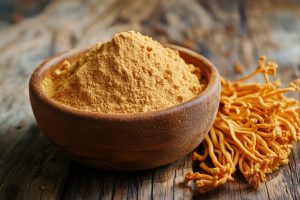
Source: By Yel D’ohan – CC BY-SA 4.0, https://commons.wikimedia.org/w/index.php?curid=77143927
As we begin to move out of the winter months and start to see the buds forming on the branches of trees, we can look towards the emergence of this life in a way which sets us up for a more energetic season. We can notice this energy rising after the inward pull of winter, where we become more aware of the possibilities as we slowly start to recalibrate our systems after a period of rest.
The collective sense of wanting to move again after a period of stagnation can allow us to cultivate our vitality, and thaw ourselves out of this period, similar to how the soil begins to thaw and breathe again, and more life is allowed to emerge. This connection to nature can position our vitality in a way which is responsive and rhythmic, and there is one fungus in particular which can provide this deep connection.
Cordyceps as a Springtime Ally

Having been historically reserved for royalty, this mushroom has possibly been used for over a thousand years in Southeast Asia, with at least 300 years of being featured prominently in Traditional Chinese Medicine (TCM) and Tibetan folk medicine. Its reverence in TCM is down to the consumption of cordyceps as a remedy to support vitality and energy, sexual dysfunction, lung health, and provide support to the kidneys.
The association of cordyceps with increased energy could be down to its ability to reduce symptoms of fatigue associated with exercise. As someone who struggles a lot with fatigue, I have found cordyceps to be an incredibly supportive ally when it comes to this specifically. I’ve not really found anything which works as well, and part of this might to be related to the effect of cordyceps in assisting with VO2 max, which is how efficiently our body makes use of oxygen in our body.
In TCM, it’s referred to as a “Yang tonifier” where it assists with a more highly energised state of being, and this could be down to the bioactive compound cordycepin stimulating the release of the molecule Adenosine Triphosphate (ATP) which is essential for mitochondrial function. This enhances cellular function, as well as muscle function, focus, and immune health. Cordyceps can provide energy which can lead to this highly energised state without feelings of overstimulation or aggression, as it allows our body to return to a balanced state where we can think of this fungus as an essential nutraceutical pathway.
Vitality without Burnout

So what is the difference between stimulation and nourishment? With coffee being the most widely-consumed beverage in the world, we might be mistaken for thinking that existing in this hyper-stimulated state is nourishing us, or even normal in the first place. Many people in the world however (myself included) experience “caffeine sensitivity” where the effects of coffee on our body and mind is simply too much – symptoms such as heart palpitations or anxiety might be common, as well as potential digestive issues which make consuming caffeinated beverages almost impossible.
At this time of year, perhaps we could benefit more from support rather than trying to force through an energetic state, or potentially increase our levels of stress with over-consumption of caffeine. Spring energy might require more resilience, rather than something which could potentially create unwanted side-effects and lead us to having a crash, rather than consuming something which provides more sustained support.
With possibly over 75% in the world suffering from burnout, it’s not surprising that we need to look for complimentary avenues to support our resilience and wellbeing. Cordyceps might just be what we’re looking for at this time of year, where it can facilitate us in continuing whatever work we’re doing, as well as supporting the different transitions in our lives.

Cordyceps, Breath, and Practical Integration
The relationship between cordyceps and lung health shows us where breath can be a meeting point of body and spirit, allowing us to find a rhythm and understand vitality within the context of presence. Our breath can be linked to resilience, creativity, and emotional stamina, where we’re able to feel confidence in the coming months ahead.
Spring can be a time for gentle expansion, where we begin to engage more with the world physically, and this is where cordyceps can be integrated quite comfortably into your daily routine. Whether you’re consuming capsules, liquid extracts, or powder in tea, there’s many ways to get this mushroom into your body to provide this extra support and resilience.
I personally work with it best in the morning, as it provides such a wonderful lift, but you can utilise it at whatever time of day suits you best to give you that extra energetic support. The emergence of Spring can offer an invitation to work with cordyceps as an ally for steadiness and resilience, in a way which allows us to move forward through the year in a positive way.
When working with cordyceps, I like to look for a product which has been hot water extracted (you don’t necessarily need dual-extract, but there are some beneficial terpenes which might be missed out with just a hot-water extraction) With a recent enforcement on the ban of cordyceps militaris (along with turkey tail) in the UK, customers are having to turn towards cordyceps sinensis, which seems to have a lower amount of bioactive compounds, such as cordycepin, compared to the militaris strain.
The dual-extract powder can be useful if you’re wanting to push your dose a bit higher without having to consume lots of capsules – I really enjoy mixing the cordyceps powder into warm cacao (hot water can denature some of the bioactive compounds) but capsules can provide more consistent and accurate dosing. Generally speaking, most people are taking between 500mg-100mg of extract powder per day, but you might want to increase or decrease depending on your level of activity.
When it comes to stacking with psilocybin mushrooms, the evidence seems to be quite limited, however there are products being sold which emphasise the combination of cordyceps with psilocybin. The energising effect from the cordyceps can provide a more intense experience compared to other stacks, but this can be very beneficial for someone who might struggle with fatigue in their daily life. Ideally you would want to consume this stack at the start of the day, on an empty stomach and before any physical activity as the compound cordycepin breaks down relatively quickly in our system, so we want to get the most out of the combination.
As with all things you consume, it’s important to make sure that the cordyceps product has gone through proper third party testing, as well as understanding the nuances, and finding ways to seek out more information when it comes to integrating mushrooms into our healthcare routine.
To learn more about my work, take a look at The Fungi Consultant

Oli Genn-Bash is a fungi consultant, educator, and writer specializing in functional and medicinal mushrooms. His work brings together contemporary research, traditional knowledge, and lived experience to support thoughtful, responsible engagement with fungi. Oli offers consultancy, workshops, and education for individuals and organizations, with a focus on stress, cognition, immune health, and sustainable integration.